
If your commercial rooftop unit is blowing warm air, short cycling, or struggling to keep up on hot Florida afternoons, the first diagnosis you’ll often hear is “low refrigerant.” It’s an easy answer, and sometimes it’s the correct one. But at Pappas Parts & Service Inc., we’ve learned that low refrigerant is frequently a symptom, not the root cause. Add refrigerant without finding out why the system is underperforming, and the problem almost always comes back — usually within a season, and usually at a worse time than the first visit.
This article walks through a real rooftop unit service call our technicians recently completed, where a low refrigerant reading masked two much bigger issues: a restrictive equipment curb and a blower wheel caked with dirt and debris. We’re sharing the photos from the job so property owners and facility managers can see exactly what a proper diagnosis looks like, and why Pappas Parts & Service Inc. always looks past the gauges before reaching for a refrigerant hose.
The Easy Answer Isn’t Always the Right One
Refrigerant pressure readings are one of the first things a technician checks on a rooftop unit, and low pressure readings can genuinely look like a low refrigerant charge. The trouble is that low airflow across the evaporator coil produces the exact same symptom. When air isn’t moving through the coil the way it should, the refrigerant can’t absorb heat properly, pressures drop, and the gauges point straight at “low refrigerant” even though the charge itself may be perfectly fine.
Adding refrigerant to a system that’s actually suffering from an airflow restriction doesn’t fix anything. It just masks the real issue for a little while, wastes money on refrigerant that wasn’t need, and puts extra strain on the compressor. This is exactly the trap our technicians avoid on every commercial HVAC repair call — and it’s why our diagnostic process always includes a full airflow inspection, not just a set of gauge readings.
The Job: A Rooftop Unit with Poor Airflow
On this particular call, the customer’s complaint was simple: the unit wasn’t keeping the space comfortable, and airflow at the registers felt weak. A less thorough technician might have hooked up gauges, seen a low refrigerant reading, topped off the charge, and moved on to the next job. Our technician instead climbed up to the rooftop unit and went straight to the source: the blower compartment.
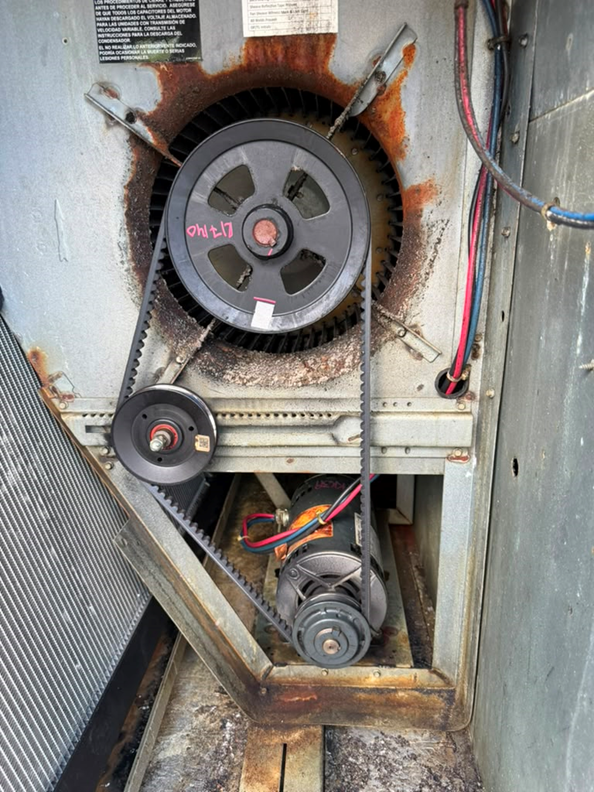
The blower wheel and belt-drive assembly inside the rooftop unit, before any repair work began.
Issue #1: An Adapter Curb Restricting Airflow
The first problem our technician found was structural. This rooftop unit was sitting on an adapter curb — a transition piece used when a replacement unit doesn’t match the footprint of the original equipment. Adapter curbs are common and often necessary, but if they aren’t sized and install correctly, they can pinch the return or supply air path right at the connection point.
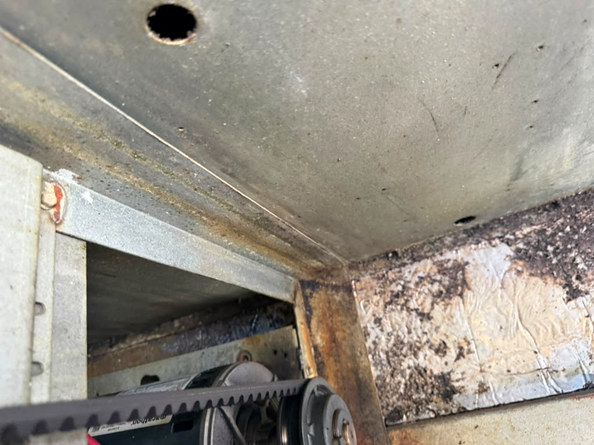
A close-up view of the tight, restrictive ductwork transition inside the curb area.
A restricted curb behaves a lot like a kinked garden hose: the blower motor is still running, the belt is still turning, but the unit simply can’t pull or push the volume of air it was design to move. Over time, that forces the system to work harder to hit the same temperature, drives up energy costs, and can cause the exact low-pressure symptoms that get mistaken for low refrigerant. This is one of the reasons commercial HVAC repair isn’t something that should be rush — airflow restrictions like this are easy to miss if you’re not physically inspecting the equipment.
Issue #2: A Blower Wheel Coated in Dirt and Debris
The second, bigger issue was the blower wheel itself. Once our technician got a good look at it, the fins were heavily coat in a thick layer of dirt, grease, and debris. A dirty blower wheel doesn’t just look bad — it changes the aerodynamics of every fin, reducing the volume of air the wheel can move even when the motor is running at full speed.
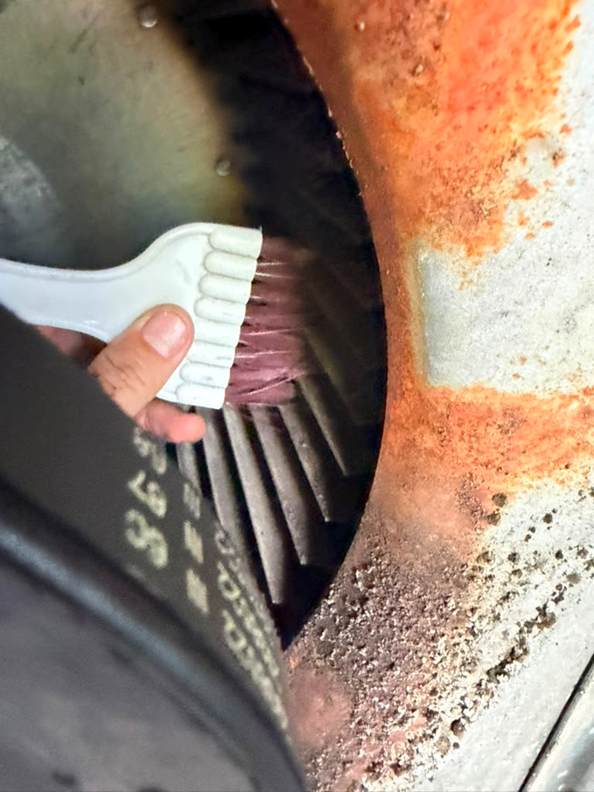
The blower wheel fins were caked in dirt and debris, choking off airflow before the repair.
This kind of buildup happens gradually, which is part of why it’s so often overlooked. Grease-laden air from nearby kitchen exhaust, dust, pollen, and everyday airborne debris settle onto the blades a little at a time. Six months in, the loss of airflow might be barely noticeable. A year or two later, that same buildup can cut blower performance dramatically — again showing up on the gauges as what looks like a low refrigerant condition.
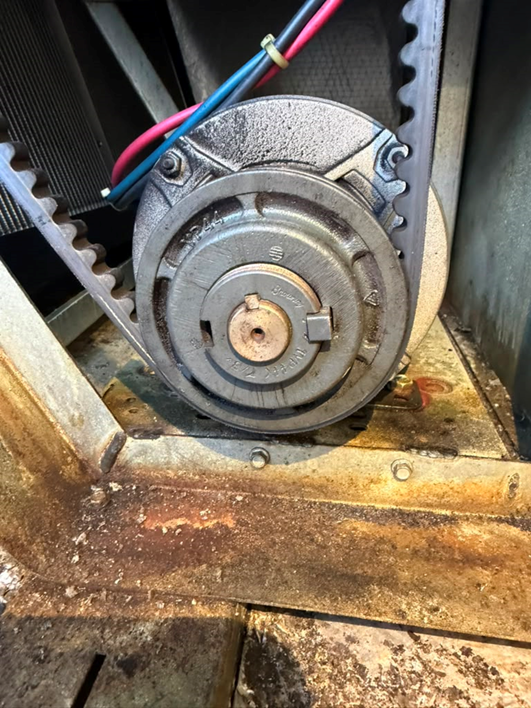
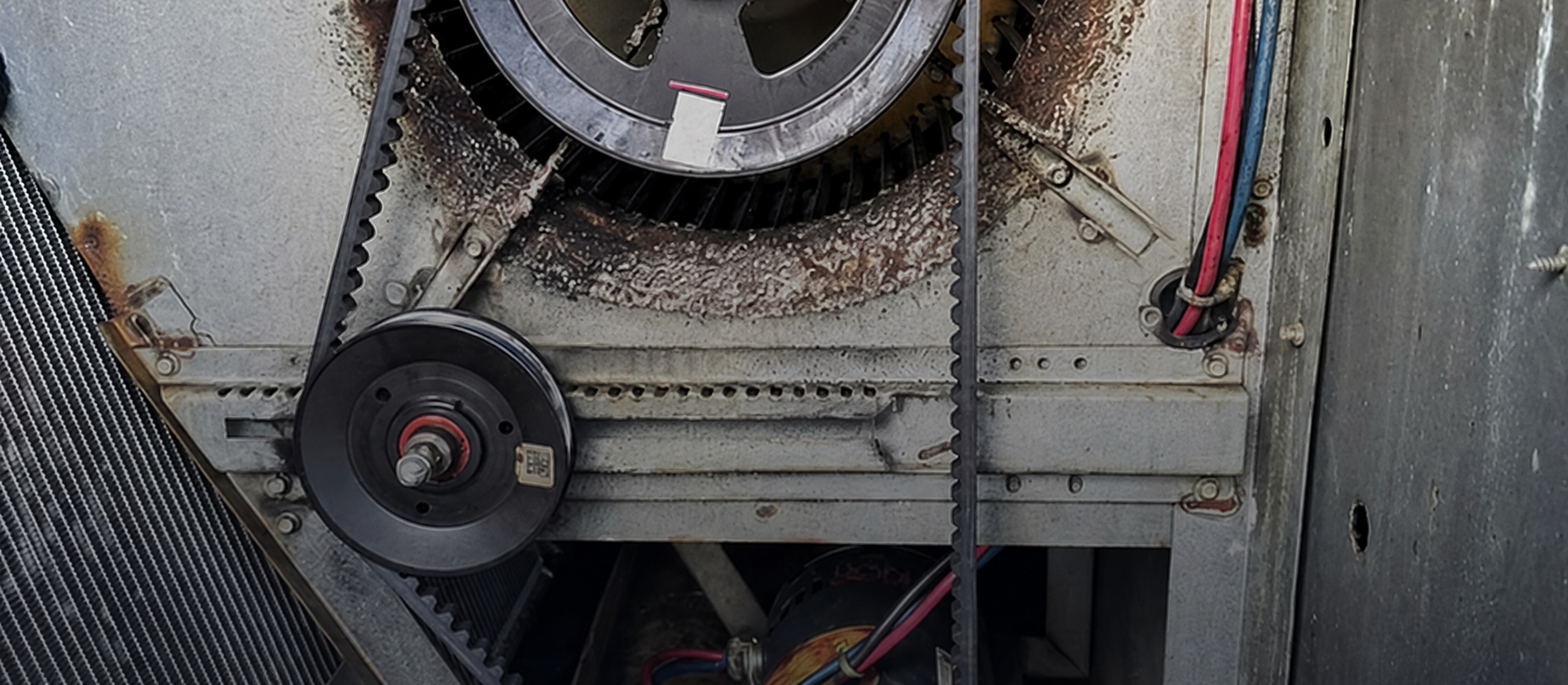
The blower motor and pulley assembly, mounted just below the blower wheel housing.
The Repair: Cleaning the Wheel and Adjusting the Sheave
Once both issues were identifie, our technician got to work. The blower wheel was thoroughly clean fin by fin to strip away the dirt and debris that had been choking off airflow. With the wheel clean, the true condition of the blower drive could finally be assess.
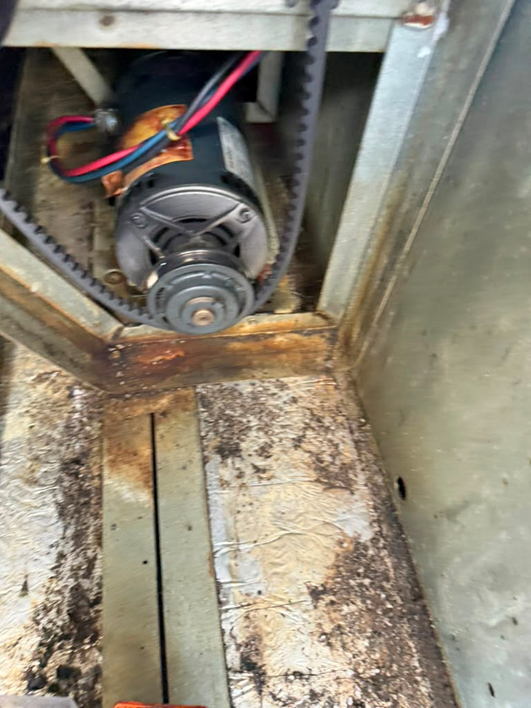
A wider view of the blower motor and belt inside the rooftop unit compartment.
From there, our technician use a clamp meter to check the actual running amp draw on the blower motor, confirming the motor had the capacity to move more air once the restriction was clear.
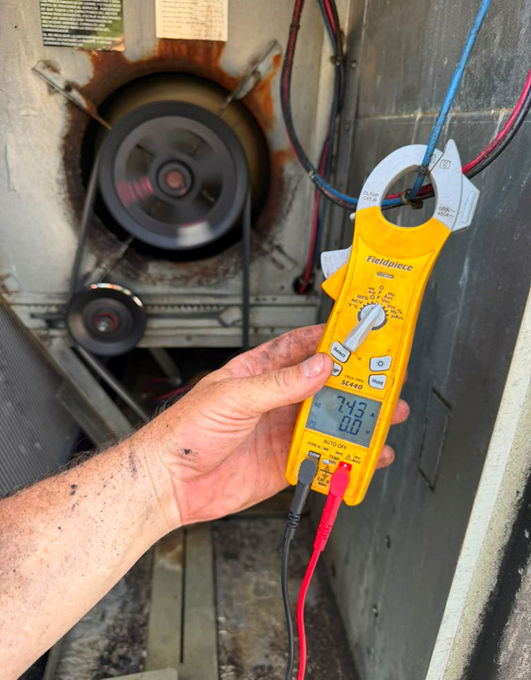
Checking amp draw on the blower motor with a clamp meter to confirm safe operating capacity.
With that confirmed, the technician adjusted the variable-pitch blower sheave to increase the blower RPMs. This is a precise, hands-on adjustment — turning the sheave changes the effective pulley diameter, which changes belt speed and, in turn, how much air the blower wheel moves per minute. Too little adjustment and the airflow problem persists; too much and the motor can be overloaded. It has to be dialed in and verified, not guessed at.
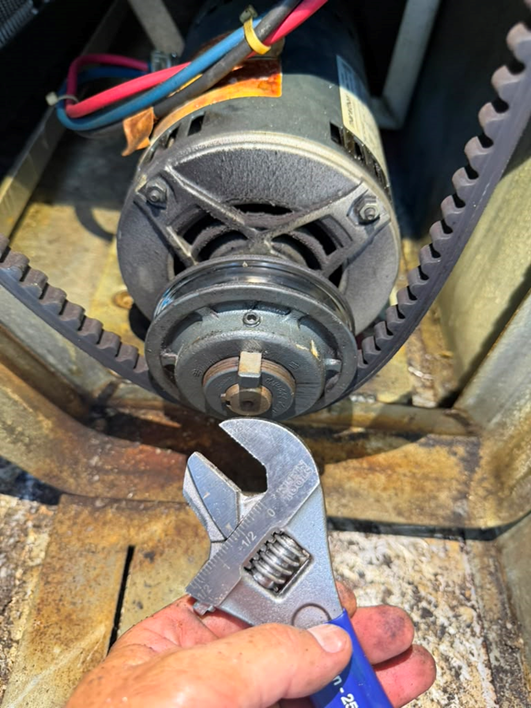
Adjusting the variable-pitch blower sheave to fine-tune blower speed.
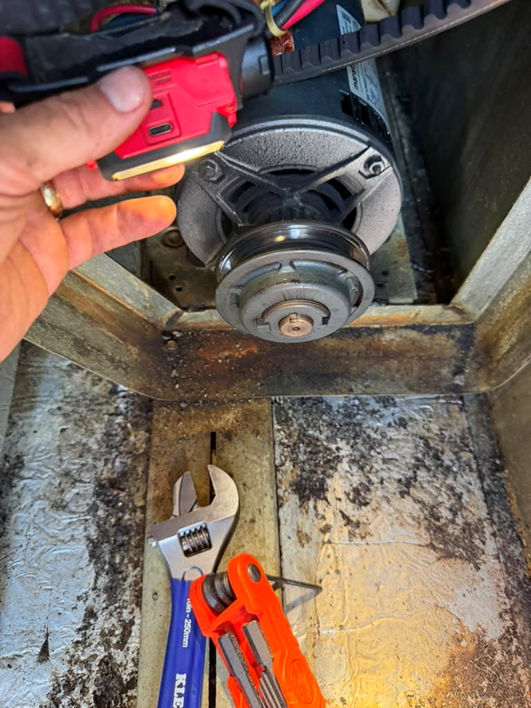
A close inspection of the sheave and bearing assembly before final adjustments.
The belt tension and pulley alignment were rechecked at every step, and the amp draw was verified again once the RPM adjustment was made, keeping the motor safely within its rated range while delivering meaningfully more airflow through the coil.
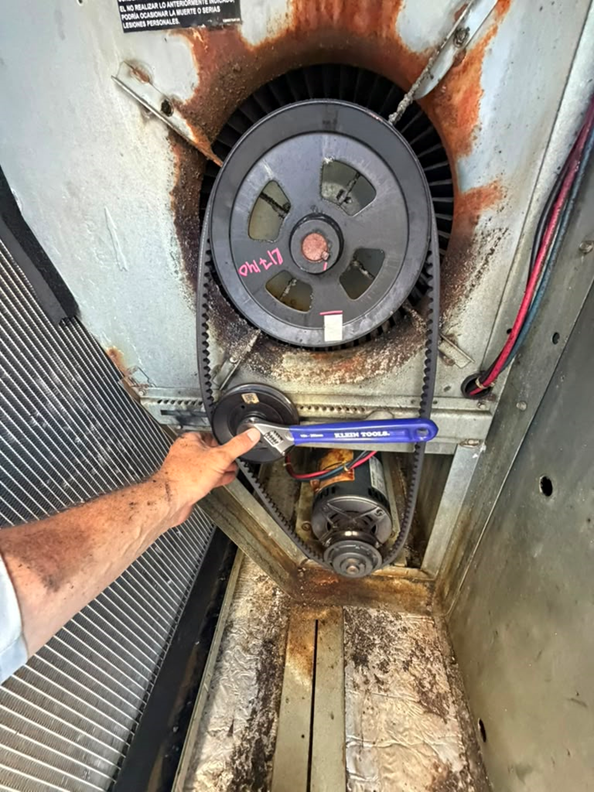
Final adjustment and inspection of the blower pulley and belt drive on the rooftop unit.
Why Airflow Matters as Much as Refrigerant Charge
It’s tempting to think of refrigerant charge as the heart of an air conditioning system and airflow as an afterthought, but the two work as a team. Refrigerant can only absorb and release heat efficiently if enough air is moving across the coils to carry that heat away. Restrict the airflow — whether from a pinch curb, a dirty blower wheel, a clogged filter, or a poorly adjust sheave — and the whole system suffers, regardless of how perfectly the refrigerant is charge.
- Reduced comfort: weak, uneven airflow means hot and cold spots throughout the building.
- Higher energy bills: a system fighting a restriction runs longer and harder to reach set point.
- Premature equipment wear: motors, compressors, and belts all take on extra strain when airflow is restrict.
- Misdiagnosis and wasted refrigerant: technicians who don’t inspect airflow may repeatedly add refrigerant to a system that never actually needed it.
This is exactly why our technicians treat low refrigerant readings as a starting point for investigation, not an automatic conclusion. Whether it’s a rooftop package unit, a split system, or a piece of commercial refrigeration equipment, the same principle applies: airflow and refrigerant charge have to be evaluate together.
Warning Signs Your System May Have an Airflow Problem
- Weak airflow at the vents or diffusers, even with the blower running
- The system runs constantly but never quite reaches the thermostat setpoint
- Higher-than-normal energy bills without an obvious cause
- Frequent “low refrigerant” top-offs that don’t solve the comfort complaint for long
- Unusual noise, vibration, or belt squeal from the blower compartment
- Ice forming on the evaporator coil or refrigerant lines
If any of this sounds familiar, it’s worth having a technician physically inspect the blower assembly, the equipment curb, and the ductwork — not just hook up gauges and read pressures. You can browse examples of the kind of hands-on diagnostic work we do in our project gallery.
The Real Cost of Chasing the Wrong Diagnosis
Every time a system gets an unnecessary refrigerant top-off, a facility is paying for a fix that doesn’t address the actual problem. Meanwhile, the underlying airflow restriction keeps costing money in the background — through higher utility bills, shortened equipment life, and comfort complaints that never fully go away. On this job, if the technician had simply chased the low refrigerant reading, the customer would likely have called back within weeks with the same complaint, and the equipment curb and blower wheel would still have been silently working against the system.
Instead, because the diagnosis went past the gauges, the rooftop unit now has a clean blower wheel, a properly adjusted sheave, and airflow that matches what the equipment was actually design to deliver. That’s the difference between a quick fix and a repair that actually holds up. Whether the equipment in question is a rooftop package unit, a residential HVAC system, or older equipment nearing the end of its service life and due for an AC installation or replacement, the same rule holds: find the real cause before reaching for a quick patch.
Why Property Owners Trust Pappas Parts & Service Inc.
At Pappas Parts & Service Inc., our technicians are train to look at the whole system, not just the number on a refrigerant gauge. We check blower wheels, sheaves, belts, curbs, filters, and ductwork as a routine part of any performance complaint, because a system that isn’t moving air correctly will rarely show its true colors on a pressure reading alone. You can learn more about our team and our approach on our about, and see the full range of work we handle on our services.
We proudly serve property owners, facility managers, and homeowners throughout Northeast Florida and Southeast Georgia. You can see the communities we cover on our service areas and our areas we serve overview, and read more diagnostic breakdowns like this one on our HVAC blog.
Don’t Let a “Low Refrigerant” Label Hide the Real Problem
If your rooftop unit, split system, or commercial refrigeration equipment keeps struggling despite repeated refrigerant top-offs, it may be time for a technician who checks the whole picture — not just the pressure gauges. Pappas Parts & Service Inc. is ready to inspect your blower assembly, ductwork, and equipment curb to find out what’s really limiting your system’s performance.
| Ready for a Real Diagnosis? Schedule a full airflow and refrigerant inspection with Pappas Parts & Service Inc. today — we’ll find the real cause, not just the easy answer. Contact Us Today → |
| Happy With Your Service? If Pappas Parts & Service Inc. has helped keep your equipment running, we’d love your feedback — it helps other property owners in our community find honest, experienced technicians. Leave Us a Review on Google → |
Whether it’s a rooftop package unit misdiagnosed as low refrigerant, a dirty blower wheel, or an equipment curb quietly restricting airflow, Pappas Parts & Service Inc. is committed to finding the real problem the first time. Explore our commercial food service equipment and full lineup of services, or reach out any time — we’re here to keep your equipment running the way it should.
