
When a rooftop unit dies in the middle of a Florida summer, your customers, staff, and inventory feel it within hours. Warm dining rooms, sweating employees, and closed doors cost far more than the equipment itself. Yet many owners put off commercial rooftop unit replacement because they do not know what it costs, how it works, or how long the building will be disrupted.
This guide answers those questions in plain language. At Pappas Parts & Service, we replace rooftop units for restaurants, retail stores, offices, and warehouses, and we use a crane on many jobs. Below you will find realistic cost ranges, our step-by-step process, timelines, and tips to keep your project on budget.
| Rooftop unit down or failing? Get a fast assessment and a clear written quote. Call Pappas Parts & Service 24/7 at (904) 649-5702 and we will get you cooling again. |
What Is a Commercial Rooftop Unit (RTU)?
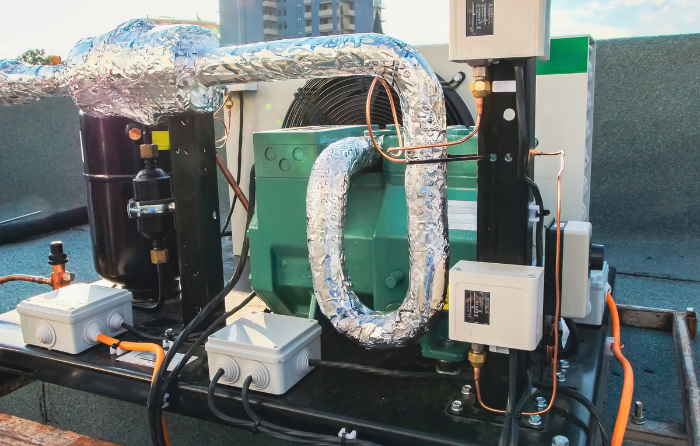
A rooftop unit is a self-contained heating and cooling system installed on a building’s roof. It combines the compressor, condenser, evaporator coil, blower, and often a gas furnace or electric heat in one cabinet. Conditioned air travels through ductwork into the space below. Because everything sits outdoors on a roof curb, RTUs save interior floor space and make service convenient, which is why they dominate small and mid-size commercial buildings.
Most rooftop units last 15 to 20 years with good maintenance, though hot, humid, salty coastal air can shorten that. When the unit reaches the end of its life, commercial rooftop unit replacement is usually the smartest long-term move.
Signs It Is Time for Commercial Rooftop Unit Replacement
- Age of 15 years or more, especially with a history of repairs
- Rising repair bills, with two or more major repairs in a single year
- Higher energy bills with no change in usage or hours
- Uneven temperatures, hot spots, or humidity that never drops
- Frequent breakdowns during peak summer or winter demand
- Rust, corrosion, or refrigerant leaks on the cabinet, coils, or lines
- Loud noises such as grinding, rattling, or hard starts from the compressor
Repair or Replace? A Simple Rule of Thumb
A useful guide: if a repair costs more than about half the price of a new unit, or the system is past 15 years and unreliable, replacement usually pays off sooner. A failed capacitor, contactor, or fan motor on a healthy unit is a good candidate for commercial HVAC repair. A failed compressor, a cracked heat exchanger, or a leaking coil on an aging unit usually is not. We give you an honest recommendation either way, because a repair that only delays the inevitable wastes your money.
Commercial Rooftop Unit Replacement Cost
Every building is different, so treat the numbers below as general ranges, not a quote. Cost depends mainly on unit size, efficiency, and how much extra work the roof needs.
| Unit size | Typical use | Typical installed range |
| 3 to 5 tons | Small shop, salon, office suite | $8,000 to $18,000 |
| 7.5 to 10 tons | Restaurant, retail store, clinic | $15,000 to $30,000 |
| 12.5 to 20 tons | Large restaurant, grocery, warehouse | $25,000 to $50,000+ |
What moves your price up or down:
- Tonnage and efficiency rating. Higher-efficiency equipment costs more upfront and saves on power bills for years.
- Crane and rigging. Most rooftop jobs need a crane, which is usually a modest part of the total.
- Roof curb condition. A matching curb costs little, while an adapter or new curb adds cost.
- Ductwork, gas, and electrical changes needed to connect the new unit.
- Permits and inspections required by your local building department.
- Controls and options, such as economizers, smart thermostats, and remote monitoring.
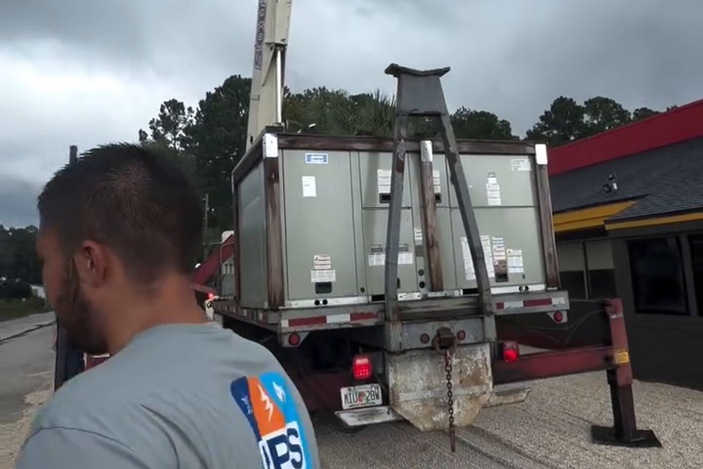
A new rooftop unit arrives on a flatbed and is ready to be rigged for the crane lift.
The Commercial Rooftop Unit Replacement Process, Step by Step
A well-run replacement follows a clear order. Here is how our team handles it:
- Assess the system. We inspect the old unit, curb, roof, ductwork, gas line, and electrical service.
- Size the new unit. A proper load calculation matches capacity to your space, since oversizing wastes energy and undersizing never keeps up.
- Provide a written quote. You get clear options, such as standard and high-efficiency, with no pressure.
- Order equipment and schedule. We confirm lead times and pick a date that limits disruption to your business.
- Pull permits. Required permits and inspections are arranged before installation day.
- Crane lift. The old unit comes off the roof and the new one goes up in a controlled, rigged lift.
- Connect and seal. We reconnect ductwork, refrigerant or gas, electrical, and condensate, and seal the curb against leaks.
- Commission and test. We verify airflow, pressures, temperatures, and controls, then walk you through the results.
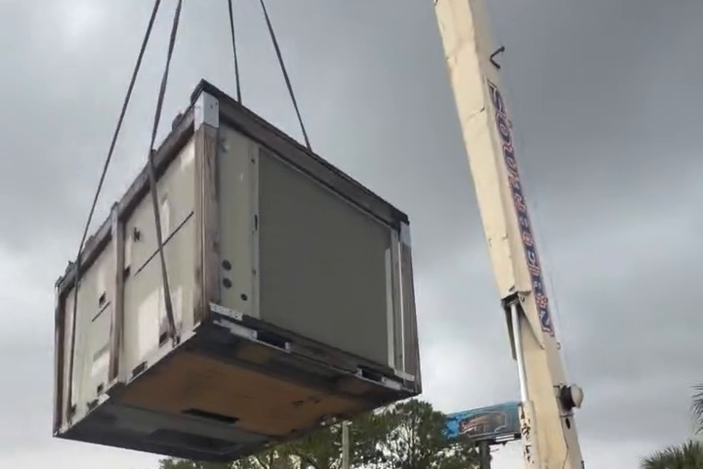
A crane lifts the new unit off the flatbed with the load carried on rigging straps.
What Crane Day Looks Like
Crane day is the most visible part of commercial rooftop unit replacement, and it is well planned. The truck and crane are positioned with room to swing the load, the rigging is checked, and the area below is kept clear. One technician guides the load while the operator lifts it slowly, and the unit is set gently onto the curb. Weather matters: we watch wind and lightning, because safety always comes before schedule.
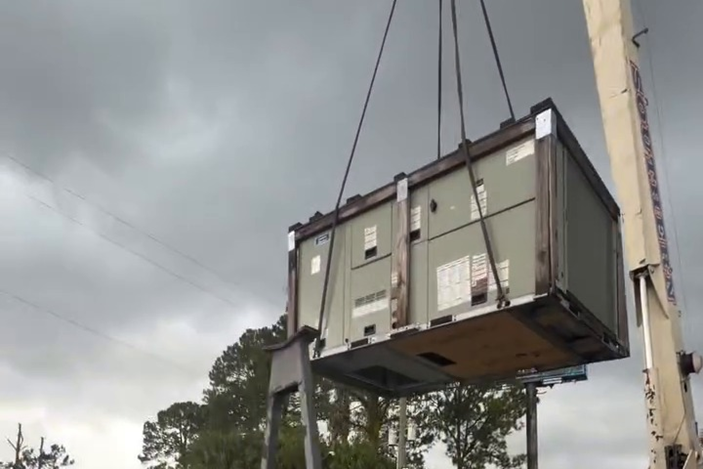
The unit is hoisted in one controlled lift, guided by our technicians.
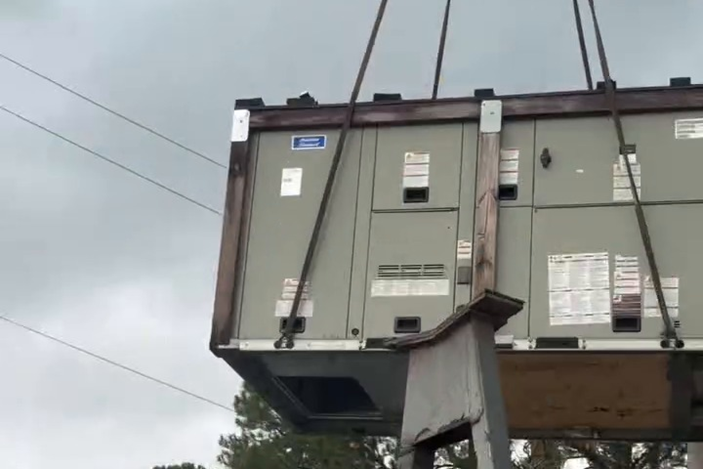
A close look at a rooftop unit in the air: rigging, balance, and clearances are checked before the lift.
How Long Does Commercial Rooftop Unit Replacement Take?
The installation itself is often fast, but the full project has more stages than most owners expect:
- Site visit and quote: usually a few days
- Equipment lead time: from a few days for common sizes to several weeks for specialty or high-efficiency units
- Permits: varies by jurisdiction, often one to two weeks
- Installation day: commonly one day for a like-for-like swap on a matching curb
- Extra time: an additional day or two if the curb, ductwork, gas, or electrical need changes
If your unit fails suddenly, tell us your deadline. We can often speed up ordering and scheduling, and in an emergency we can help with temporary cooling options while the new unit is on its way.
| Want a clear price for your building? Every rooftop is different. Request a free replacement quote and we will inspect your unit, size the replacement, and explain your options in writing. Prefer to talk? Call (904) 649-5702. |
How to Prepare Your Business for Replacement Day
- Confirm roof access and tell staff or tenants the date and expected noise
- Clear parking or delivery space where the truck and crane will set up
- Move anything fragile away from the area directly below the roof work
- Share access details, such as roof hatch, ladder, and any alarm codes
- Ask about after-hours scheduling for restaurants and retail stores
Choosing Efficient Equipment and Refrigerant
New rooftop units are more efficient than models from a decade ago, and that matters when cooling runs nearly year-round. Compare efficiency ratings, ask about variable-speed compressors and fans, and consider an economizer where it makes sense. Refrigerants are also changing: newer equipment is moving to lower-global-warming-potential refrigerants, so ask which one your new unit uses and how it affects future service. A good contractor explains these trade-offs in plain terms and shows you the payback, not just the price.
Common Mistakes to Avoid
- Waiting for total failure. Emergency replacement costs more and limits your choices.
- Choosing the lowest bid only. Compare equipment, warranty, permits, and what is actually included.
- Skipping the load calculation. Copying the old unit’s size can lock in an old mistake.
- Ignoring the curb and ductwork. Leaks and poor connections waste energy from day one.
- Skipping maintenance afterward. A new unit still needs regular service to reach its full life.
Protecting Your New Rooftop Unit After Installation
A new unit performs best when it is maintained from day one. Schedule preventive service twice a year, ideally before spring and before peak summer. Each visit should include cleaning the condenser and evaporator coils, changing filters, checking belts and motors, testing electrical connections, inspecting the condensate drain, and confirming refrigerant pressures. Coastal humidity and salt air are hard on rooftop equipment, so regular coil cleaning matters even more here. Consistent maintenance protects your warranty, lowers energy costs, and catches small problems before they turn into emergency calls.
The Real Cost of Waiting
Putting off commercial rooftop unit replacement rarely saves money. An aging unit burns more electricity, breaks down at the worst times, and can force an emergency replacement with limited equipment choices and rushed scheduling. Add lost sales, uncomfortable customers, and spoiled inventory in the heat, and the delay often costs more than planned replacement.
Frequently Asked Questions About Commercial Rooftop Unit Replacement
How much does commercial rooftop unit replacement cost?
Most projects range from about $8,000 for a small unit to $50,000 or more for large systems, depending on size, efficiency, crane needs, and curb or duct work. A site visit gives you an exact number.
How long does rooftop unit replacement take?
Installation is often completed in one day for a like-for-like swap. The full project, including ordering and permits, can take from a few days to several weeks.
Do I need a crane to replace a rooftop unit?
In most cases, yes. Rooftop units are heavy and awkward, so a crane is the safest and fastest way to remove the old unit and set the new one.
Will my business have to close during replacement?
Usually not for long. Installation is often done in a single day, and we can schedule around your busiest hours. Cooling may be off for part of that day.
Should I repair or replace my rooftop unit?
If the unit is over 15 years old or a single repair costs about half the price of a new one, replacement usually makes more sense. We will tell you honestly which option fits your situation.
What warranty comes with a new rooftop unit?
Manufacturer warranties commonly cover parts and often the compressor for several years, and labor coverage varies by contractor. Ask for warranty terms in writing before you sign.
Why Businesses Choose Pappas Parts & Service
We are a multi-generational, family-owned company with hands-on experience in commercial HVAC, refrigeration, ice machines, and cooking equipment. See the full range of commercial HVAC and refrigeration services we offer. What sets us apart:
- Licensed and fully insured, Florida License #CAC1824133
- 24/7 emergency dispatch when your cooling cannot wait
- Honest, upfront pricing with a written quote before work starts
- Five-star Google reviews from local businesses and homeowners
- Factory-trained technicians who explain every step
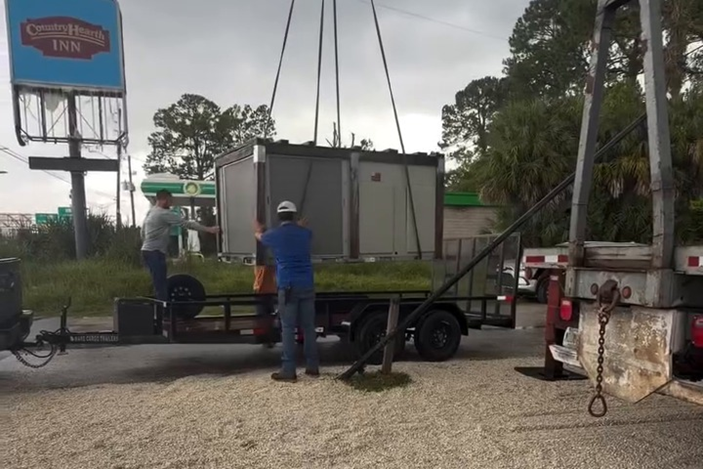
Our crew guides the unit into position during a commercial rooftop unit replacement.
We work across Northeast Florida and neighboring areas. Check our full list of service areas or call if you do not see your town. You can also browse recent jobs in our project gallery.
If you are also weighing a new system for a different building, our AC installation and replacement team can size and price that project too.
Final Thoughts
Commercial rooftop unit replacement does not have to be stressful. Know the warning signs, budget with realistic ranges, and choose a contractor who sizes the system correctly, handles permits and the crane lift, and tests everything before leaving. Plan ahead and you can replace on your schedule, not in the middle of a heat wave.
| Cooling down? We answer 24/7. Call Pappas Parts & Service at (904) 649-5702 or visit us at 86029 Sinatra St, Yulee, FL 32097. Happy with our work? Find us and leave a review on Google. Email: Pappaspartsandservice@gmail.com |
