
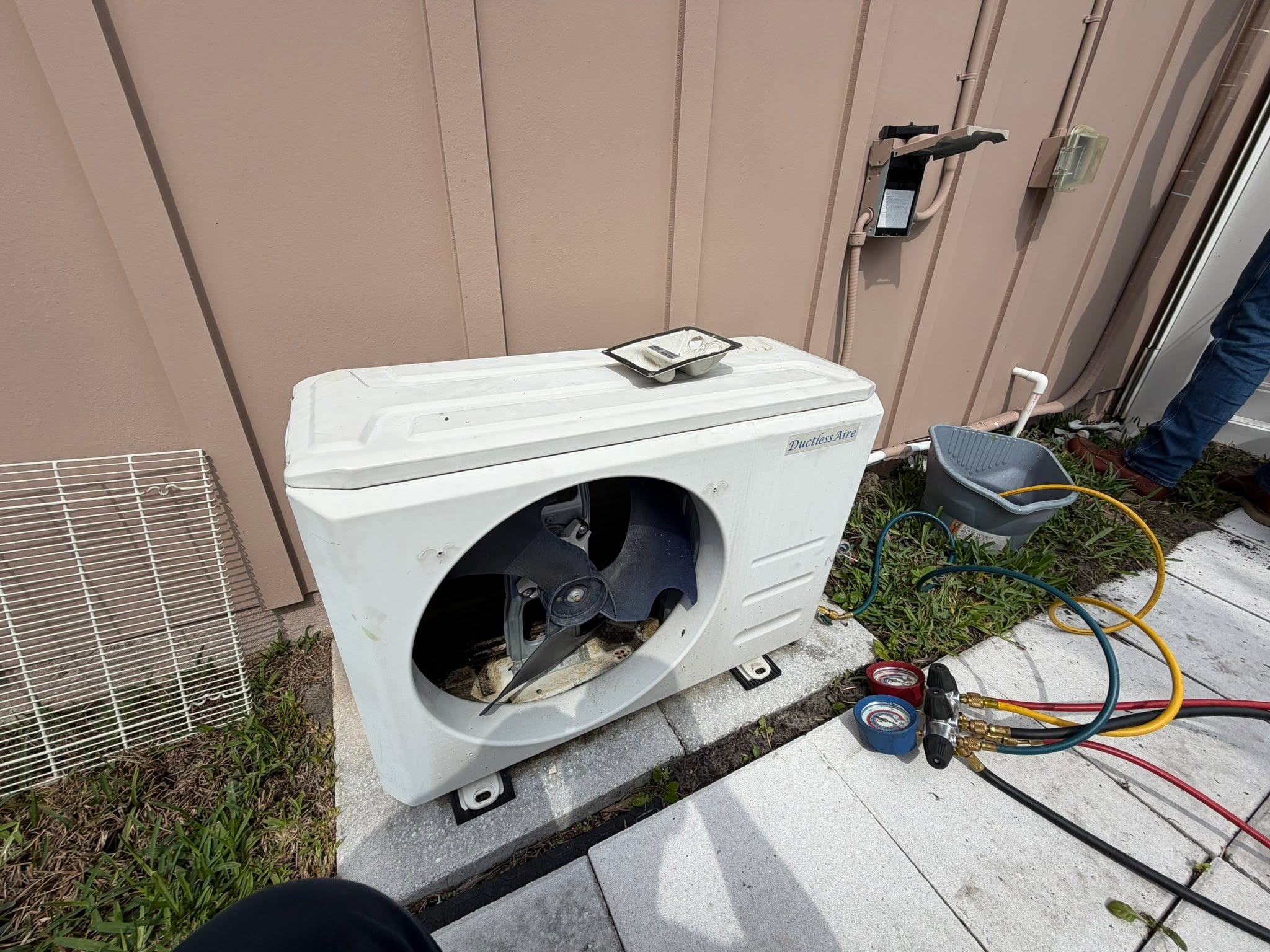
There’s a moment during every mini split installation that most homeowners and business owners never think about — and it’s arguably the most important moment of the entire job.
The technician picks up a wrench, leans in toward the copper line set, and tightens the flare connector. In most cases, it takes about 30 seconds. And in most cases, it’s done entirely by feel — no measurement, no verification, no documentation.
At Pappas Parts & Service, Inc., we do it differently. We use a calibrated digital torque wrench to hit the manufacturer-specified torque value on every single mini split flare connection we make. It takes longer. It costs us more per job. And we do it anyway — because our customers deserve a system that works right the first time, and keeps working.
This post explains exactly what a flare connection is, why torque matters so much, what can go wrong when it’s done incorrectly, and what questions you should ask any HVAC technician before they touch your equipment.
What Is a Mini Split System, and Why Is the Flare Connection So Important?
A mini split system — also called a ductless mini split or ductless AC — connects an indoor air handler to an outdoor compressor unit through a set of refrigerant lines, electrical wiring, and a condensate drain line. Unlike traditional central AC systems that push cooled air through ductwork, mini splits deliver cooling and heating directly to individual rooms or zones.
These systems are increasingly popular in Jacksonville, Nassau County, and throughout Northeast Florida for a few key reasons:
- They’re energy-efficient — no energy loss through leaky ductwork
- They work great in homes without existing ductwork, additions, and garages
- Restaurants and commercial kitchens use them to cool specific prep areas or offices
- They’re quiet, effective, and relatively low-maintenance when installed correctly
The refrigerant line set is the copper piping that carries refrigerant between the indoor and outdoor units. At each end of this line set — where it connects to the indoor unit and the outdoor compressor — there’s a flare fitting: the copper tube end is flared outward into a cone shape, and a flare nut is used to clamp it against the fitting port to create a leak-proof seal.
This connection point is the most failure-prone part of any mini split installation. And it all comes down to one number: torque.

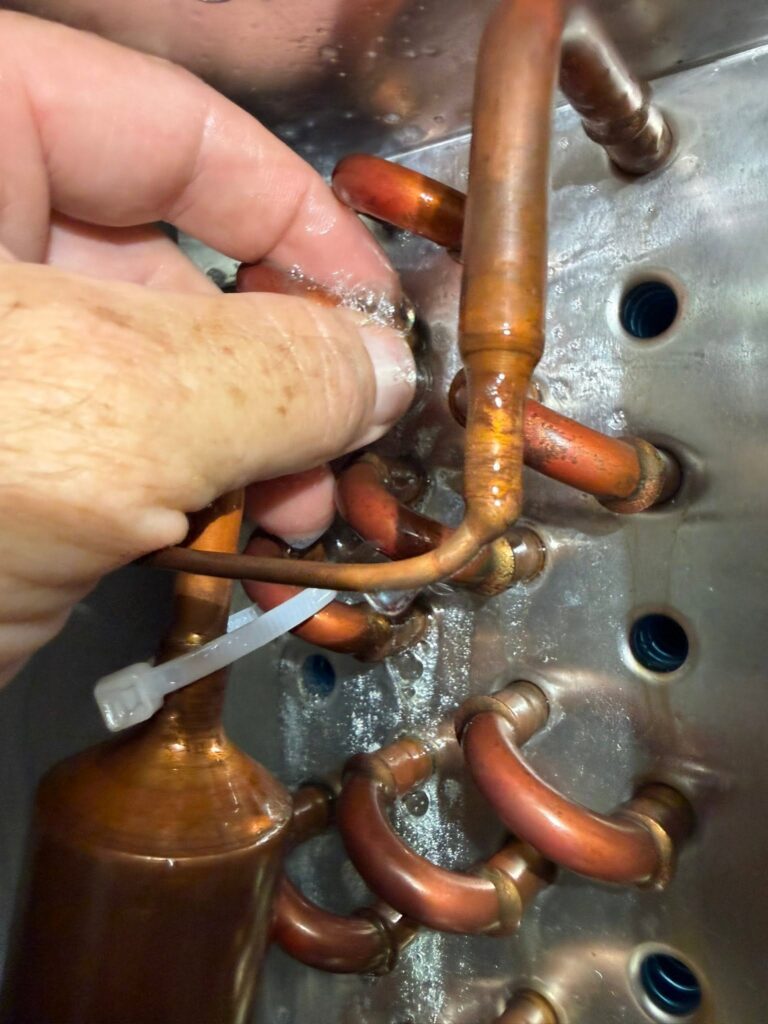
Pappas Parts & Service technician searching for a refrigerant leak on an R290 evaporator coil during a mini split service inspection.
What Is Torque, and Why Does It Matter for Flare Connections?
Torque is the rotational force applied when tightening a fastener — in this case, the flare nut. It’s measured in foot-pounds (ft-lbs) or Newton-meters (Nm). Every mini split manufacturer publishes a specific torque specification for their flare connections, and that spec varies based on the line size (typically 1/4″, 3/8″, or 1/2″ for residential and light commercial systems).
For example, a 1/4″ flare connection on a common brand might require 18 ft-lbs of torque. A 3/8″ connection might require 33 ft-lbs. These are not guidelines — they are engineering specifications designed to ensure the copper seats properly without deforming.
What Happens If You Over-Tighten?
Over-tightening a flare nut is one of the most common mistakes in the field. When a technician cranks a flare nut past its specification, they can:
- The copper deforms under excess stress, creating micro-fractures that refrigerant slowly leaks through
- The nut threads or the fitting port can be damage, requiring costly component replacement
- The seal geometry is compromise, and even a tiny gap is enough for refrigerant to escape
The frustrating part about over-tightening damage? It often doesn’t show up immediately. The system may work fine for weeks or months before the micro-fracture grows large enough to cause detectable refrigerant loss. By the time you notice reduced cooling performance, you may have lost a significant portion of your refrigerant charge.
What Happens If You Under-Tighten?
Under-tightening is equally problematic, but it tends to show up faster. A flare nut that isn’t fully seat will vibrate loose over time as the compressor cycles on and off. Common consequences include:
- Immediate refrigerant leaks after startup
- Gradual performance loss as refrigerant escapes over days or weeks
- Oil migration into the refrigerant lines as the system runs low on charge
- Compressor damage if the system continues to run in a low-refrigerant state
Both failure modes — over-tightening and under-tightening — are entirely preventable with a calibrated digital torque wrench and a few minutes of careful work.
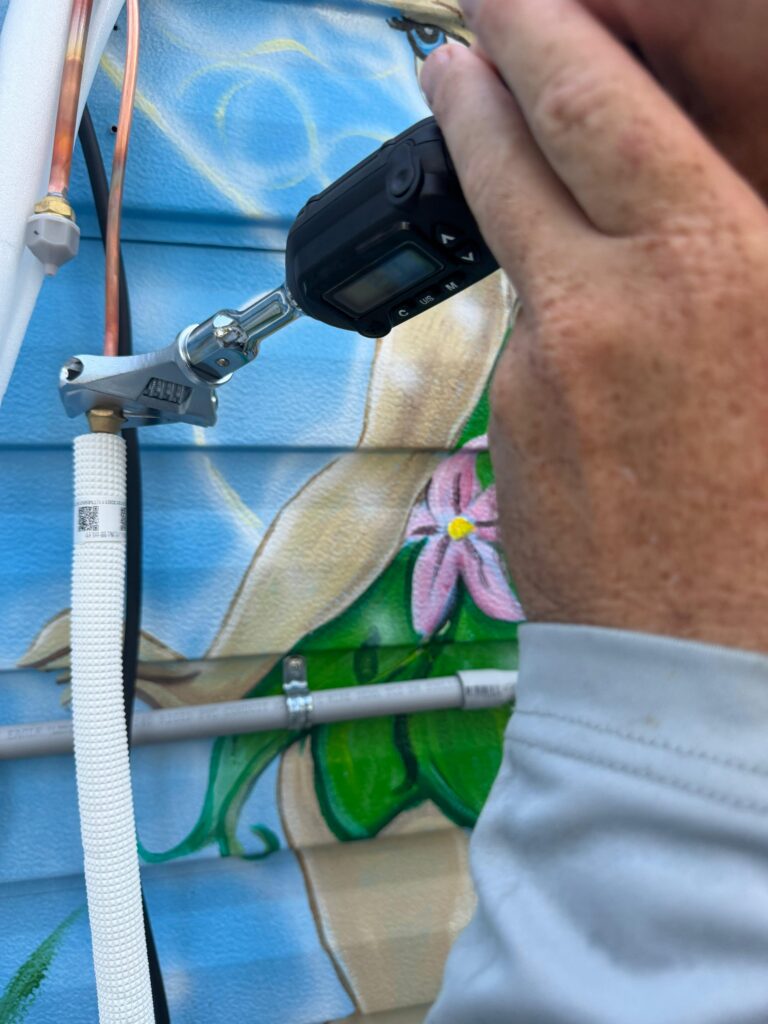
Using an electronic leak detector to inspect the R290 evaporator coil for refrigerant leaks before verifying the flare connection torque.
Why Most HVAC Companies Don’t Use a Digital Torque Wrench
Here’s the honest truth: using a torque wrench takes longer, and in a high-volume service business, speed is money. Many HVAC companies — particularly larger franchise operations and lower-cost providers — train their technicians to tighten flare connections by feel, using what’s called “wrench feel” or “turn of the nut” methods.
Experienced technicians can develop a reasonably good feel for torque over years of practice. But “reasonably good” isn’t the same as correct. And when you’re dealing with a closed refrigerant system — one that requires special equipment to diagnose, charge, and repair — “reasonably good” can turn into an expensive callback.
At Pappas Parts & Service, we chose early on to invest in proper torque tools and train our technicians to use them on every job. Not because it’s require by law, but because it’s the right way to do the work.
| Why We Use Digital Torque Wrenches on Every Job: • Manufacturer warranty protection — many brands void warranties if torque specs aren’t followed • Refrigerant accountability — proper connections reduce refrigerant loss and EPA reporting concerns • Customer trust — when we leave a job, we know it’s right. No callbacks, no guessing. • Long-term system performance — a properly torqued flare connection lasts the life of the equipment |
A Real-World Example: What This Looks Like on the Job
Recently, our team was dispatched to properly inspect and set the torque on a mini split line set at the flare connector — a job that came in after a previous installer had complete the work without torque verification.
When we arrived, the system was running but performing below spec. After diagnostics, we found a slow refrigerant leak at the flare connection on the indoor unit — a classic sign of improper installation. The flare nut had been hand-tighten and then given a partial turn with a standard wrench. No torque verification. No leak check.
Our process on this job looked like this:
- We examined the flare fitting and nut for any signs of deformation, cross-threading, or corrosion
- Before opening the system, we recovered the remaining charge per EPA regulations
- In this case, the existing flare was usable, so we cleaned and reseated it
- We set and verified the exact manufacturer torque specification for the line size
- Electronic leak detector and nitrogen pressure test to confirm zero leaks before recharging
- We recharged the system to the correct operating weight using a calibrated digital manifold gauge set
- We confirmed proper superheat, subcooling, and delta-T before leaving the job
The customer’s system has been running perfectly since. That’s the outcome we aim for on every single call.
Mini Split Installation vs. Mini Split Repair: When You Need Each
Many Jacksonville-area homeowners and business owners aren’t sure whether they need a full installation or a repair. Here’s a simple breakdown:
You Probably Need a New Mini Split Installation If:
- You’re adding cooling to a room, garage, or addition that doesn’t have existing ductwork
- You’re replacing a window unit with a more efficient permanent solution
- Your restaurant or commercial kitchen needs zone-specific cooling for prep areas or offices
- Your existing system is 10+ years old and failing repeatedly
- You want to add heating capability to a currently cooling-only space
You Probably Need Mini Split Repair If:
- Your system is running but not cooling or heating effectively
- You’re seeing ice buildup on the indoor or outdoor unit
- The system is short-cycling (turning on and off too frequently)
- You notice unusual noises (gurgling, hissing, or grinding) from either unit
- Your energy bills have increased without a change in usage patterns
- The system is displaying an error code on the indoor unit display
In both cases, Pappas Parts & Service has the tools, training, and experience to get it done right. We service all major mini split brands including Mitsubishi, Daikin, LG, Carrier, Fujitsu, and more.
Residential vs. Commercial Mini Split Applications in Northeast Florida
Mini split systems are use across both residential and commercial settings in the Jacksonville area, and the considerations are a bit different for each.
Residential Mini Split Applications
For homeowners, mini splits are most commonly use to cool:
- Bonus rooms, sunrooms, and Florida rooms
- Garage conversions and workshops
- Home offices that get too warm
- Master bedrooms for customized temperature control
- Older homes that lack central air ductwork
Our residential HVAC repair team handles residential mini split service across Nassau County, Yulee, Fernandina Beach, Callahan, and surrounding areas.
Commercial Mini Split Applications
For restaurants, retail spaces, and commercial facilities, mini splits serve critical functions:
- Cooling specific zones in a restaurant dining room or bar area
- Climate control for server rooms or office spaces within a larger building
- Supplemental cooling for commercial kitchens with high heat loads
- Cost-effective cooling for storage areas or break rooms
Our commercial HVAC repair team understands the higher stakes of commercial environments — a failed system during a busy dinner service can mean lost revenue, uncomfortable guests, and potential health code concerns.
What to Ask Your HVAC Technician Before They Start
Whether you’re hiring for a new mini split installation or a repair, here are the questions every informed customer should ask:
- Do you use a digital torque wrench on flare connections?”
- What torque spec does the manufacturer require for this line size?”
- Will you perform an electronic leak check before completing the job?”
- Are you EPA 608 certified to handle refrigerants?”
- Is your company licensed and insured in Florida?”
- Do you carry the refrigerant for my system, or will I need to wait for a recharge?”
A qualified technician will answer every one of these questions immediately and confidently. At Pappas Parts & Service, our technicians are EPA certified, Florida licensed (#CAC1824133), and fully equipped to handle every step of mini split service on the first visit.
Our HVAC & Mini Split Services
Pappas Parts & Service provides comprehensive HVAC services across Jacksonville, Nassau County, and Northeast Florida. Here are the services most relevant to mini split owners:
→ Residential HVAC Repair — Diagnosis, repair, and maintenance for home mini splits and central AC systems
→ Commercial HVAC Repair — Commercial-grade service for restaurants, offices, and retail spaces
→ AC Installation & Replacement — New mini split installations and full system replacements
→ Commercial Refrigeration Repair — Walk-in coolers, display cases, and commercial refrigeration systems
→ Walk-In Cooler Repair — Emergency and scheduled walk-in cooler service
→ Ice Machine Repair — Full-service ice machine diagnostics and repair
Need Mini Split Service in Jacksonville or Nassau County?
Pappas Parts & Service is available 24/7 for residential and commercial HVAC needs. Serving Jacksonville, Nassau County & Northeast Florida with expert mini split installation, repair, and maintenance services you can trust.
📅 Book Online Here